Margaret Bourke White
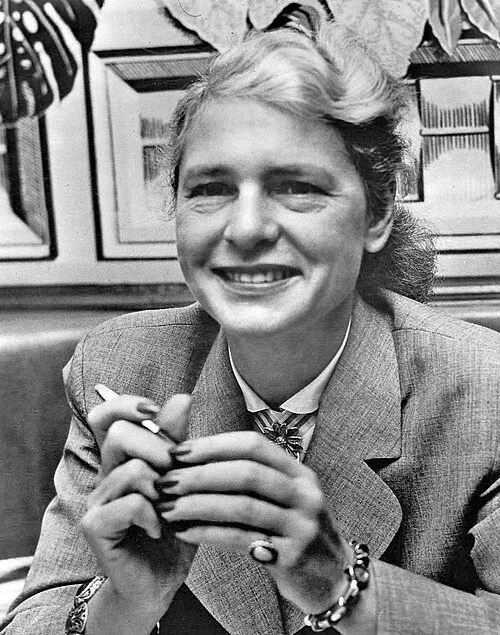
Margaret Bourke-White - Wikimedia Commons
Margaret Bourke-White: The Industrial Pioneer of the Human Condition
Before the era of instant communication, Margaret Bourke-White (1904–1971) was the eyes of the American public. From the wreckage of the Great Depression to the liberation of Nazi concentration camps and the birth of nations, her work represents the Gold Standard of photojournalism—documenting the world’s most visceral malfunctions with clinical precision.
The Institutional Firsts
A graduate of Cornell (1927), Bourke-White didn’t wait for permission; she engineered her own access. She established herself as a freelance industrial specialist before becoming the "First" in nearly every high-stakes category:
The Global Access: The first foreign photographer allowed into the Soviet Union (1930).
The Life Era: The first female photojournalist for Life Magazine, with her shot of the Fort Peck Dam gracing its inaugural 1936 cover.
The War Correspondent: The first woman accredited as a war correspondent, surviving torpedo attacks and documenting the Air Force in combat.
Documenting the "Wholesale Slaughter"
Bourke-White’s lens was a tool for social extraction. In the mid-1930s, she captured the victims of the Dust Bowl. In 1937, she collaborated with Erskine Caldwell on You Have Seen Their Faces, a graphic portrayal of the rural under-class. Her work didn't just "show" poverty; it screamed it.
During the partition of India and Pakistan, she captured the definitive "DNA" of history: Gandhi at his spinning wheel and the "vacant eyes" of refugees amidst mass migration. Her shots of corpses and burnt dead bodies serve as a permanent record of the "nadir of human history," refusing to let the world look away.
The Efficiency of the Image
Whether she was covering the Korean War or the industrialization of the U.S., Bourke-White looked for the Reciprocal Signal. Her "best shot"—a returning soldier meeting his mother who thought he was dead—represents the ultimate emotional extraction. She understood that a single image could carry the weight of an entire conflict.
The Final Tally
Even when diagnosed with Parkinson’s in 1953, she maintained her "Serious Person" discipline, pivoting to write her biography, Portrait of Myself (1963). With 12 books and dozens of honorary degrees, Bourke-White proved that photography isn't just about "utility"; it is about the rationality and emotion required to illustrate the human condition.
She was a Specialist of the Extreme, proving that work—when done at the highest level—never deserts the legacy of the artist.